
STRATEGY
Big recommendations ignore the estate you actually run
The direction may sound right, but it collapses when legacy dependencies, ownership gaps, and real Microsoft operating constraints are not considered early.
Microsoft IT Consulting
Veles IT Solutions provides Microsoft IT consulting for organizations that need clear architecture direction, disciplined roadmap sequencing, and technical decisions that can be carried through endpoint, identity, governance, and operational delivery.


Across the market, IT consulting is usually sold as strategy, transformation, and expert guidance. The failure mode is familiar: the recommendations are directionally right, but they are not sequenced tightly enough for the technical and operational constraints of the estate.
STRATEGY
The direction may sound right, but it collapses when legacy dependencies, ownership gaps, and real Microsoft operating constraints are not considered early.

ARCHITECTURE
Endpoint, identity, security, and automation projects drift when architecture intent is not explicit enough to guide later delivery choices.

DELIVERY
Programs slow down when the roadmap does not account for sequencing risk, organizational readiness, or overlapping technical dependencies.

GOVERNANCE
Consulting only works when executives, technical leads, and operations teams can all see what the next operating model requires of them.
That is why Veles treats IT consulting as the work of creating usable decisions, not just polished recommendations.
Review the technical, organizational, and operational realities shaping endpoint, identity, governance, and supportability decisions.
Define the Microsoft design direction that should govern later platform decisions instead of leaving them to project-by-project interpretation.
Turn the architecture into a practical order of work that respects dependencies, risk, business readiness, and control requirements.
The strongest IT consulting offerings in the market combine strategy, design, implementation insight, and operating model thinking. For Microsoft environments, the output has to be specific enough to guide real delivery across endpoint, identity, governance, modernization, and automation decisions.
Clarify ownership boundaries, governance patterns, escalation logic, and what the environment needs to stay supportable after implementation.
Create enough clarity for leadership, engineering, and operations teams to make the same set of decisions from the same architectural logic.
Keep the advisory work grounded in what later delivery teams actually have to build, migrate, govern, and run.
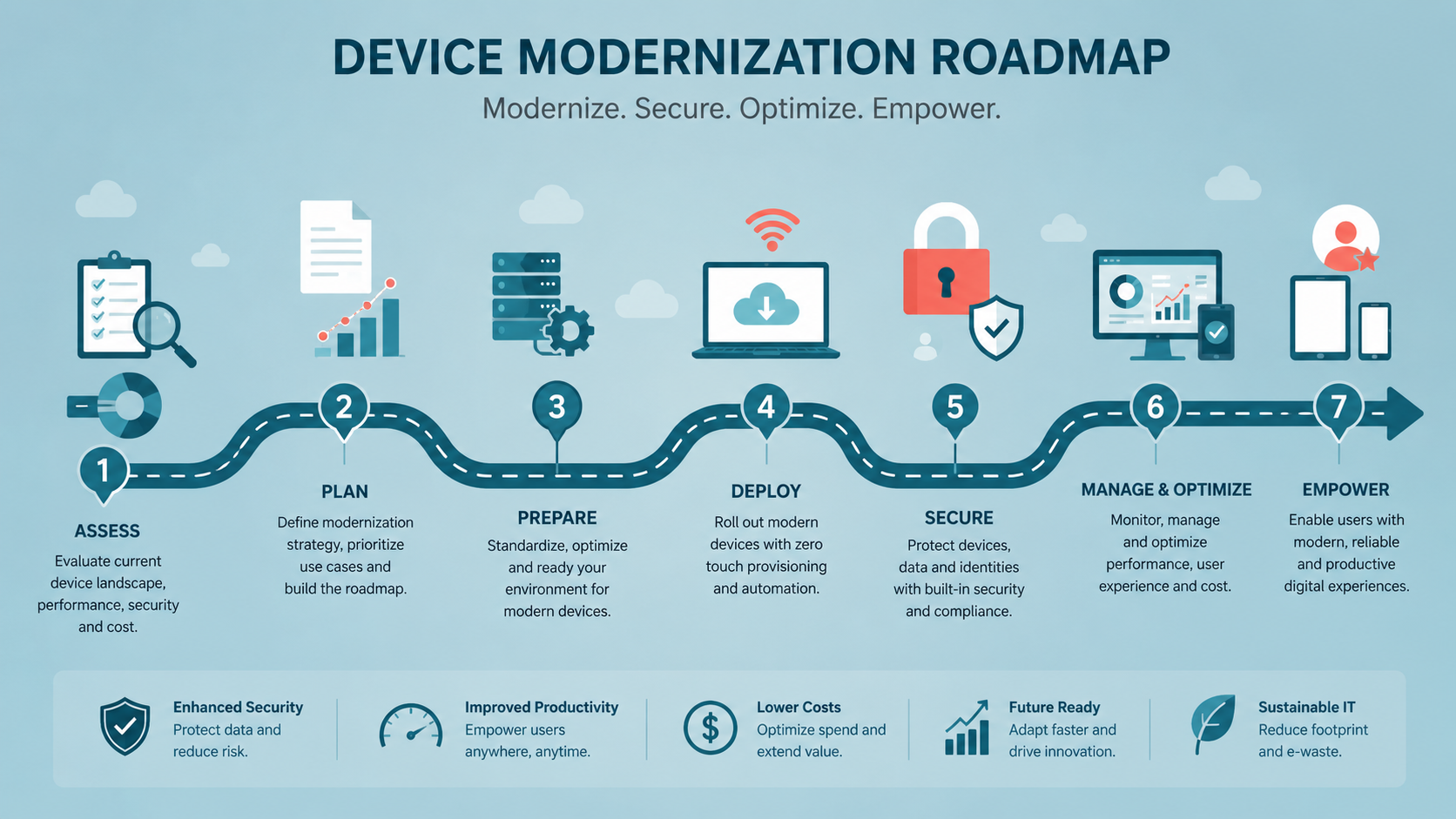
Strong consulting should turn ambiguity into a target-state view that makes Microsoft platform boundaries, priorities, and tradeoffs understandable to decision-makers.
That gives executives, technical owners, and delivery leads a shared rationale before endpoint, identity, governance, or automation work starts moving independently.
The plan has to survive prerequisites, ownership transitions, change windows, and support reality. That is where consulting either becomes useful or stays theoretical.

Reference architecture and decision support for endpoint control, provisioning, policy, compliance, and supportability.
Learn moreIdentity-led architecture guidance across Entra, Conditional Access, device trust, and role models.
Learn moreControl design, reporting, exception handling, and governance patterns that inform later delivery.
Learn moreModernization sequencing for hybrid environments with overlapping dependencies and real operational constraints.
Learn moreConsulting that links process redesign, automation opportunities, and implementation readiness.
Learn moreOperational intelligence direction for teams that need better evidence, visibility, and decision-making across change.
Learn moreThese tracks are usually interconnected. The consulting work is there to define how they should fit together before execution gets expensive.
The goal is to move from uncertainty to an architecture-backed plan that people can execute. That means the engagement has to connect assessment, design, roadmap logic, and delivery reality from the start.
Review technical constraints, ownership patterns, existing controls, and the kinds of friction that are limiting change today.
Create the design logic that should govern later decisions across endpoint, identity, governance, modernization, or automation work.
Translate the architecture into a practical order of work with clear priorities, dependencies, and risk-aware implementation steps.
Ensure the work can continue into implementation, governance, or operational governance without losing the architectural intent.
That is what turns consulting into a usable operating path rather than an isolated advisory exercise.
See how assessment findings, target-state design, and roadmap sequencing turn consulting work into decisions teams can act on.
Current-state consulting should make dependencies, ownership gaps, and platform drift visible enough that leadership can decide what needs to change first.
The engagement should define Microsoft control boundaries, governance expectations, and the design principles later teams can keep using during implementation.
Useful consulting keeps roadmap choices connected to prerequisites, change windows, delivery risk, and the support model teams will have to run afterward.
Discovery and current-state review across architecture, dependencies, and ownership gaps.
Case Study Reference
Gibson Energy reflects the kind of Microsoft complexity where visibility, governance, and disciplined implementation logic matter. That is the same environment profile where consulting has to be precise enough to guide later delivery.
Featured case study
IT Consulting FAQ
Veles IT consulting covers Microsoft architecture assessment, target-state design, roadmap sequencing, operating model decisions, and technical guidance that can carry through into implementation and long-term operations.
Veles does not stop at a strategy deck. The consulting model is built around architecture decisions that have to survive endpoint, identity, governance, security, and operational reality in production.
Yes. We regularly continue from assessment and architecture into implementation sequencing, technical delivery, and operational handoff so the plan is usable rather than theoretical.
The strongest fit is mid-size and enterprise organizations with meaningful Microsoft complexity, competing priorities, and the need for clearer platform direction before another change program begins.
Yes. The point of the consulting work is often to create the architecture and sequencing logic that later informs cybersecurity, modernization, and automation initiatives.
Start with a consulting discussion focused on the architecture, operating model, and sequencing logic your environment actually needs.


