

Manual Routing
Email-driven processes
Critical workflows rely on inbox forwarding and manual follow-ups.
Workflow Automations
We design and deploy workflow automations that move information, trigger actions, and connect systems across Microsoft 365 and your line-of-business platforms.
Automate repetitive tasks across departments, reduce operational delays and human error, and scale operations without increasing headcount.
Teams spend hours each week forwarding emails, copying information between systems, creating tickets, updating spreadsheets, routing documents, and chasing approvals.
These tasks are rarely documented and almost never optimized.
Manual Routing
Critical workflows rely on inbox forwarding and manual follow-ups.

Integration Gap
Information must be copied between systems because they do not communicate.

Approval Lag
Managers approve requests manually through emails or chats.

Human Bottleneck
Processes slow down because specific people must perform repetitive tasks.
Automatically classify incoming emails, extract information, and route them to the correct teams.
Move documents through review, approval, and archiving workflows without manual coordination.
Standardize approval chains for purchasing, contracts, and operational requests.
The highest-value automation programs remove repetitive operational work without losing traceability, approvals, or system context.
These workflow patterns help teams automate email, documents, tickets, notifications, and data movement without losing approvals, visibility, or system context.
Automatically move information between systems to eliminate manual updates.
Convert events, forms, or alerts into structured tickets in service systems.
Notify teams automatically when key conditions occur.
When these areas are aligned, workflow automation delivery becomes easier to operate, measure, and improve without adding avoidable complexity for the team.
We design workflows that fit your current Microsoft stack and integrate with enterprise systems where needed.
Platform
Automate workflows across Microsoft 365 and trigger flows from email, SharePoint, Teams, or forms.
Use connector-based integrations and approval chains for reliable process automation.
Platform
Connect line-of-business applications and automate document processing pipelines across systems.
Trigger actions across multiple systems and combine automation with AI agents when intelligent decision support is needed.
We move workflow automation delivery from strategy to production in deliberate stages so governance, architecture, and operational ownership evolve together. Each step is meant to prove value without losing control of risk, cost, or supportability.
Identify manual workflows consuming the most operational time.
Map triggers, actions, decision logic, and integration points.
Build and test flows using secure connectors and automation tools.
Implement monitoring and fallback logic for reliability.
Deploy automation within your operational environment.
Monitor performance and refine workflows as processes evolve.
That sequence helps workflow automation delivery move into production with clearer guardrails, stronger adoption, and less operational rework afterward.
A single process visual anchors the section while the copy keeps focus on mapping, approval logic, and operational reporting.
Intake, routing, decisions, approvals, exceptions, and notifications are mapped before build starts.
Human approval, escalation, and exception paths are designed into the workflow where accountability matters.
Automation should show cycle time, exceptions, volume, ownership, and the next improvement opportunity.
Process mapping, approval logic, exception handling, and reporting connected in one workflow automation design.
Department
Automated incident ticket creation, alert routing and escalation workflows, and provisioning workflows for new devices.
Department
Email classification and routing, document submission pipelines, and project workflow coordination.
Department
Lead routing and CRM synchronization, content approval workflows, and campaign reporting automation.
Department
Invoice approval pipelines, purchase request workflows, and expense approval processes.
Workflow automation delivery is more effective when architecture, governance, operations, and rollout planning are aligned from the start. These are the areas we usually shape first so the solution is easier to adopt, support, and improve over time.
Automation is designed around operational outcomes, not just technical implementation.
Deep experience across Microsoft 365, Entra, Intune, and Power Platform.
Combine workflows with AI agents when process steps require intelligent decision support.
Workflows are implemented with proper access control and operational visibility.
When these areas are aligned, workflow automation delivery becomes easier to operate, measure, and improve without adding avoidable complexity for the team.
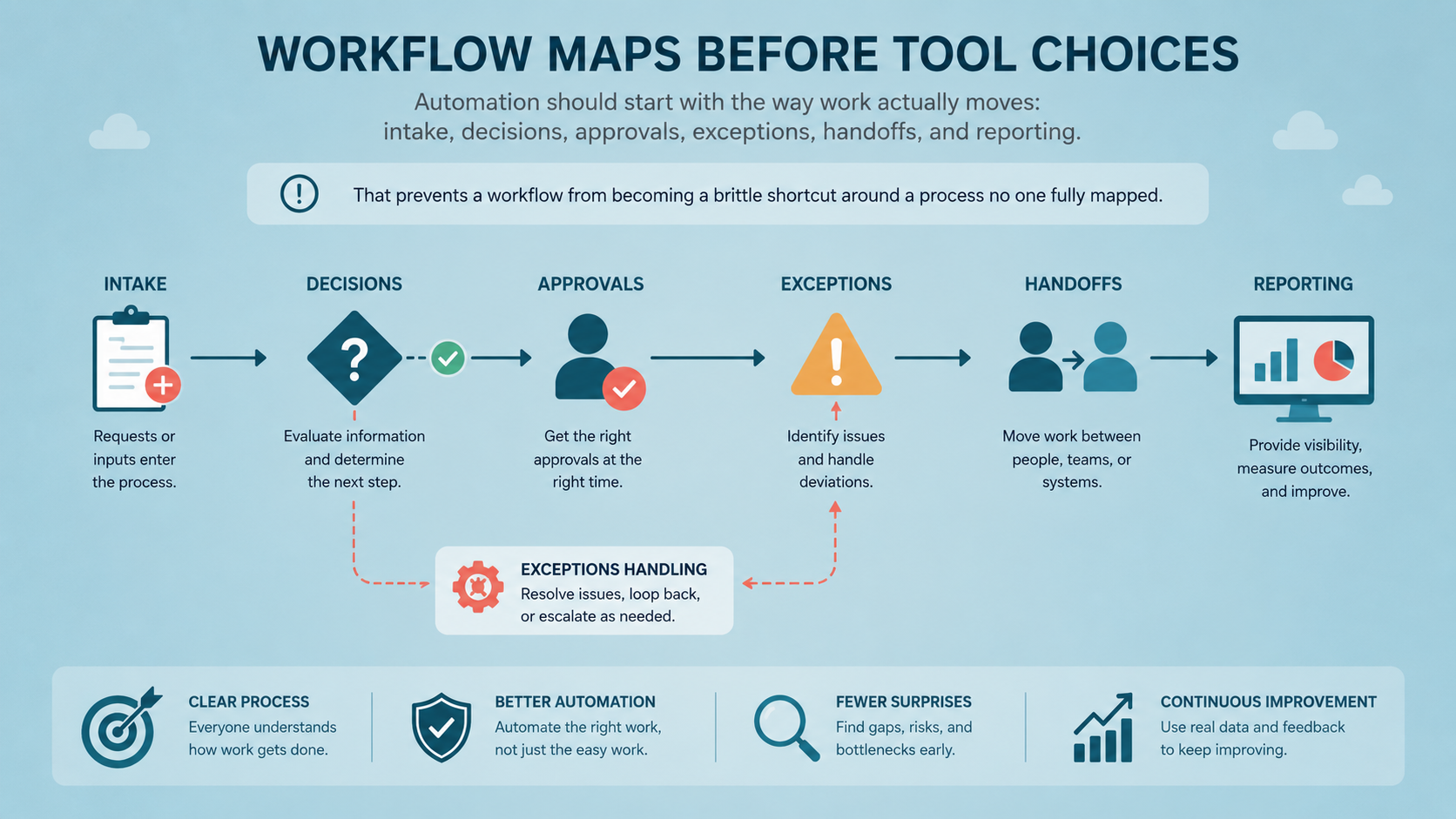
Automation should start with the way work actually moves: intake, decisions, approvals, exceptions, handoffs, and reporting.
That prevents a workflow from becoming a brittle shortcut around a process no one fully mapped.
Useful automation makes the normal path faster while preserving the review points and exception paths that keep operations accountable.

Model
Outcome: a prioritized list of high-impact automation opportunities.
Model
Outcome: production-ready automated workflows.
Model
Outcome: reliable, scalable automation operations.
We primarily use Microsoft Power Automate and related Microsoft ecosystem tools to design workflow automation across systems.
Yes. Many workflows integrate with APIs, connectors, or enterprise applications.
Simple workflows can be implemented quickly, while complex cross-system automation projects require more design and testing.
Yes. Some workflows benefit from AI agents that analyze information or make recommendations before triggering automation steps.
If your teams spend hours coordinating work through emails, spreadsheets, and manual handoffs, automation can remove those bottlenecks.


