
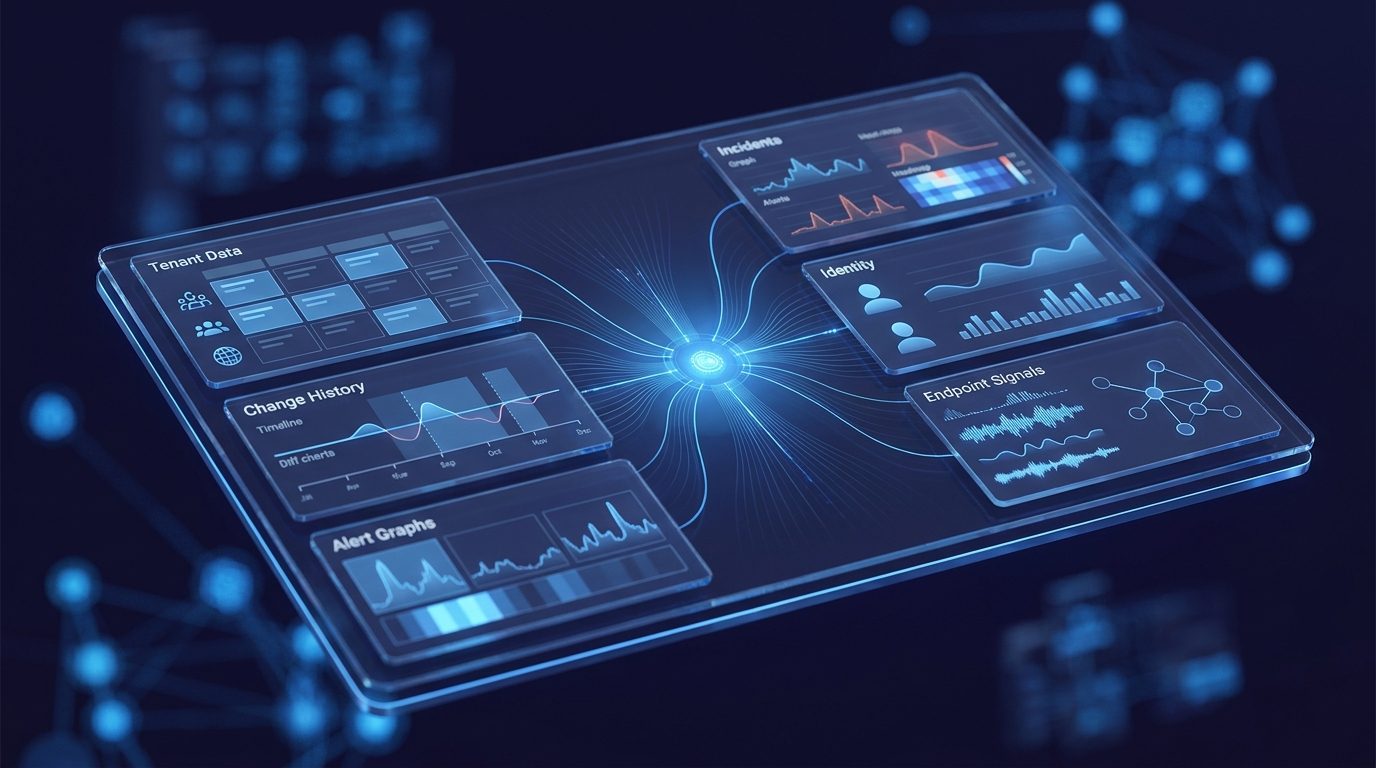
Operational intelligence only matters if it can be implemented inside the Microsoft environment itself. Operational Intelligence was built specifically to close that gap.
It functions as an operational intelligence copilot for Microsoft environments, turning fragmented tenant data into structured, explainable insight across identity, devices, policy, and infrastructure.
Instead of forcing teams to investigate manually across portals, dashboards, and tickets, Operational Intelligence supports direct questions such as:
- What changed?
- Why are users failing MFA?
- When did compliance drop?
- How was this resolved before?
Those questions sound simple. The capability behind them is not.
How Operational Intelligence Works Across Microsoft Environments
1. Cross-System Data Correlation
Operational Intelligence reads and correlates data across the Microsoft layers where enterprise incidents actually unfold.
- Intune
- Entra ID
- Microsoft 365
- Azure
- Endpoint systems
It does not analyze those systems in isolation. It links identity, device posture, policy, application state, and operational events into a unified operational view.
2. Change Awareness and Historical State Comparison
Operational Intelligence continuously tracks change across the environment and preserves the sequence behind that change.
- What changed
- When it changed
- Who made the change
It compares current and historical states to identify differences and explain likely impact. That makes change visible and understandable, not merely logged.
3. Incident-to-Change Correlation
The platform connects incidents directly to recent changes so investigations begin with evidence rather than guesswork.
- Whether an issue is isolated or recurring
- Whether similar incidents occurred before
- How those incidents were resolved
This shifts troubleshooting from exploration to evidence-based diagnosis.
4. Evidence-Based Explanations
Every answer is grounded in tenant data. Operational Intelligence is designed to explain, not speculate.
- References timestamps
- Identifies affected scope
- Separates confirmed facts from likely causes
- Avoids unsupported conclusions
That makes operational decisions more defensible, more auditable, and more accurate.
5. Institutional Operational Memory
One of Operational Intelligence's most important capabilities is persistence. It builds a historical understanding of changes, incidents, and resolutions over time.
That knowledge survives:
- Staff turnover
- Organizational growth
- System complexity
Instead of relying on individual memory, knowledge becomes part of the operating system around the environment itself.
The Business Impact of Operational Intelligence
Operational intelligence is not just a technical improvement. It changes business outcomes.
1. Reduced Mean Time To Resolution (MTTR)
When teams understand cause immediately, investigation time drops significantly.
- Faster root cause identification
- Fewer escalations
- Less time spent navigating tools
2. Fewer Repeat Incidents
When teams can identify the true cause of failure, they can eliminate recurring issues instead of treating symptoms.
- Durable fixes
- Reduced ticket volume
- Improved service stability
3. Audit Defensibility
Operational intelligence produces clear, evidence-backed narratives around change and incident response.
- Who changed what and when
- What impact it had
- How it was resolved
4. Knowledge Retention
Institutional knowledge no longer depends on the availability of a few senior engineers.
- Faster onboarding of new staff
- Reduced dependency on senior engineers
- Continuity during turnover
5. Scalable IT Operations
As Microsoft environments grow, operational complexity grows with them. Operational intelligence lets teams scale without matching that growth with headcount.
- Standardized investigation processes
- Reduced manual effort
- Consistent decision-making
From Reactive IT to Intelligent Operations
Traditional IT operations are still largely reactive. They depend on alerts, logs, and manual investigation after something breaks.
Operational intelligence introduces a different model:
- Context-driven understanding
- Evidence-based decisions
- Continuous knowledge accumulation
That is the shift that moves teams from "Something is wrong" to "We know what changed, why it happened, and how to fix it."
Where Veles IT Solutions Fits
Veles IT Solutions designs and operates Microsoft enterprise environments with clarity, structure, and control. That includes:
- Modern endpoint architecture
- Zero Trust implementation
- Identity and device governance
- Automation and operational optimization
Operational Intelligence extends that capability with a continuous intelligence layer across the environment. It changes how organizations investigate incidents, understand change, maintain operational consistency, and reduce risk.
By combining Microsoft engineering expertise with operational intelligence, Veles helps organizations move beyond reactive support into structured, data-informed IT operations.
The Bottom Line
Modern IT environments are not failing because teams lack tools. They are failing because teams lack clarity.
Operational intelligence closes that gap. It connects change to impact, turns data into explanation, and gives IT teams the confidence to act on evidence instead of guesswork.
Take the Next Step
If your team is trying to understand what changed across the environment, reduce incident resolution time, eliminate recurring operational issues, and produce clear audit-ready explanations, it is time to move beyond monitoring.
Request a Technical Consultation with Veles IT Solutions to see how operational intelligence can be implemented in your Microsoft environment.
Or discover Operational Intelligence to see how existing tenant data can be turned into real-time, explainable insight.